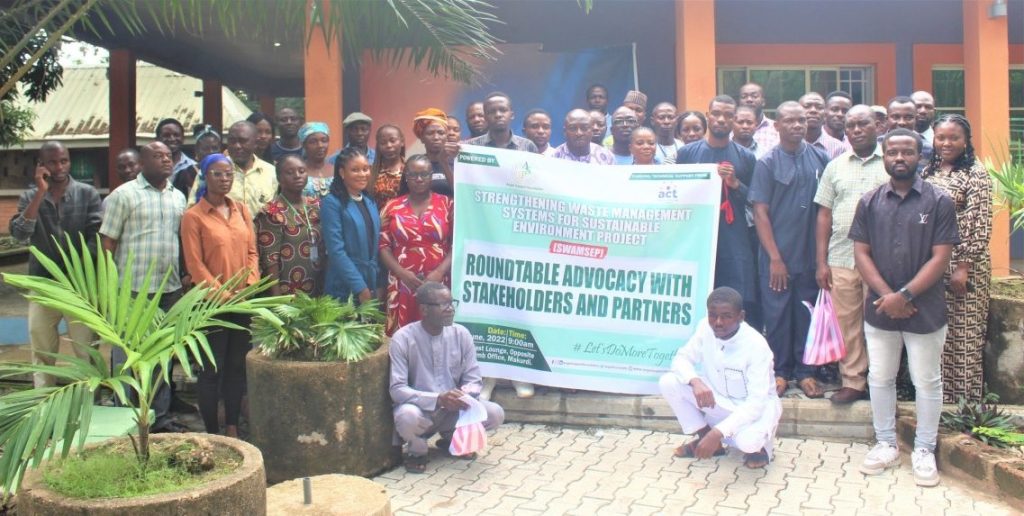
Strengthening Waste Management Systems for Sustainable Environment Project is being implemented by Angel Support Foundation with funding and Technical support from Aspire Coronation Trust Foundation Nigeria. The project which commenced in May 2022 is aimed at reaching 16 000 people on knowledge of proper waste management.
OBJECTIVE OF ADVOCACY
The objective of this meeting was to inform stakeholders about the project and discuss possible ways to manage waste as well as advocate for the approval of a designated dumpsite in Benue state capital.
A brief introduction of guest drawn from Environmental Government Agencies (State and Federal), CSO, Private waste collectors, market leaders and some business owners was done by all.
Mr. Bamber Terseer welcomed the guests on behalf of the management of Angels Support Foundation (ASF) in conjunction with ACT Foundation. He expressed his deep desire that by the end of the meeting, the thoughts expressed will go a long way to giving the needed attention to the problem of waste management currently faced in Makurdi and Benue state at large.
GOODWILL MESSAGES.
Guest present were impressed to have been invited to be a part of the advocacy meeting, stating that it was timely. They expressed their resolve to show commitments on their own part in finding a workable solution to the issue of environmental waste management.
OVER VIEW OF PROJECT
Emmanuella Ikomongave a general review of the Strengthening Waste Management Systems for Sustainable Environment Project (SWAMSEP). She identified that the project is a 12 month calendar project which targets 16,000 beneficiaries drawn from schools and communities located in the 11 council wards of Makurdi. Part of the SWAMSEP objectives are monthly sanitation, community advocacy and building of plastic brick toilet in selected schools in Makurdi.
DISCUSSIONS ON CHALLENGES OF WASTE MANAGERS AND THE CURRENT SITUATION IN MAKURDI LG.
Peace Iorwuese facilitated this discussion. The guests expressed their concerns and challenges they have faced while on duty of providing environmental services, Mr. Ibuh Terkula of BENSASA was of the opinion that most private waste collectors came into the business unprepared. He expressed dissatisfaction in service recipients that they do not have the willingness to pay for waste collected from their premises. He further noted that absence of vehicles has also greatly weakened the system.
Mrs Chile Serumun Mabe (NESREA) pointed out that lack of awareness as well as poor attitudinal state of people has also aggravated the problem of waste management. She further stated that waste should be seen as wealth and not a problem
On his part, Mr. Adaji Samuel Abu (BERWASA) called on private waste collectors to rise up to their responsibility of waste management. He said the office is always available to listen to the concerns and ready to help the best they can to the challenges faced by private waste collectors.
Mr. Asogbo Victor; an environmental activist and a private waste collector identified the issues that have been drag footing waste collection to be: multiple taxation, absence of designated dump site, high cost of running business and unwillingness of service recipients to pay for service rendered. Mr Ibrahim Terngu (Wurukum Market Chiarman) and Mr. Samson Labe (Water Company) called for government assistance and provision of incinerator respectively to help tackle this problem. Ben Odo (Devtrain) stated existing laws should be deliberately enforced.
The session was interesting as most speakers identified the need for urgent attention.
ANALYSIS OF THE NATIONAL ENVIRONMENTAL HEALTH PRACTICE REGULATIONS ACT.
Mr. Loko Tarfa presented a paper on the topic titled Analysis of the National Environmental health practice Regulations ACT. The key points identified was that laws should be enforced and special court should be established to give speedy attention to the issues of environmental offenders. Reacting to this, Mr Ben Akaka emphasised that we can’t have a society when we destroy the environment. Mr. Ibuh added that Nigeria has one of the environmental policy formulations in the world. Mr. Ben Odo warned against showing partiality to environmental offenders. While Mr. Solomon Ikyo (HOSCOAN) called for more awareness.
DISCUSSIONS ON ACTIONABLE POINTS AND WHAT STAKEHOLDERS NEEDS TO DO, TO REVERSE THE SITUATION OF WASTE MANAGEMENT
Tsavnande Michelle led the discussion. Guest stated that waste collection should be professionalized and not let to be handle by unskilful persons, more funding of the sector, establishment of neighbourhood sanitation communities to take the responsibility seriously and conflict of interest between service providers and government agencies should be resolved. Mr. Ibuh further stated that waste should be sorted before disposal, he emphasised that waste management is not just the business of the service provider but also of the service recipients.
Mr. Asogbo further emphasised on the need of a designated dump site saying the dump site in North Bank has be closed by the local communities who had become so angered by the nuisance arising from the mismanaged site. He stated that an ideal dumpsite should meet set up in line with international best practice. Mr. Odo warned against politicization of the sector. He narrated of the opportunities that are there in in waste collection. He gave an instance on citizen who is into the business of collecting leather, rubber and metals in Makurdi and how the business has been paying off well. Mr. Ibrahim expressed his commitment, he shared how under his watch, Wurukum market has been managing waste generated in the market even with the low availability of funds.
GROUP WORK: DEVELOPING AN ACTION PLAN AND WAY FORWARD
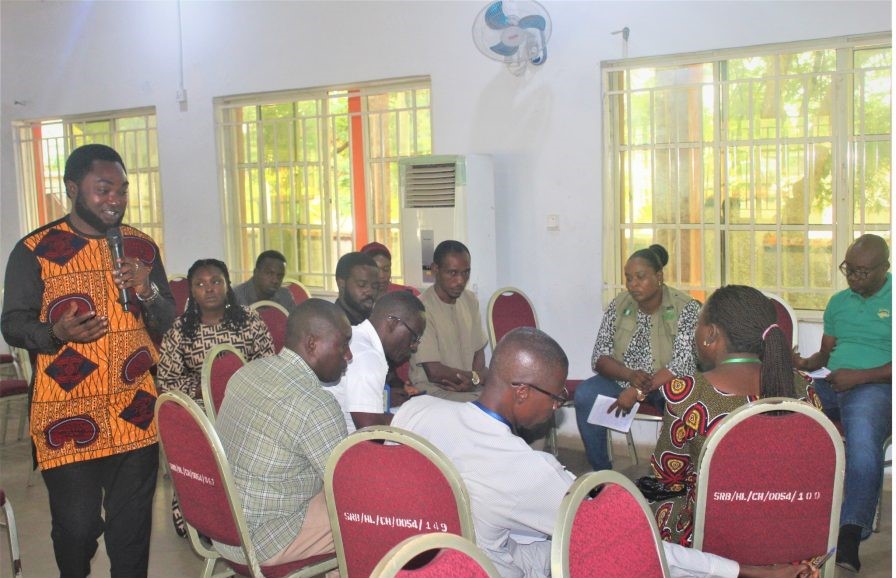
Two groups Government Agencies with CSO’s and Private waste collectors with Business owners were set to deliberate an action plan and proffer a way forward. Mr Bamber Terseer gave a template. The groups presented a communique on the challenges, solutions, timeline and responsibilities to the house as ASF collated the findings.